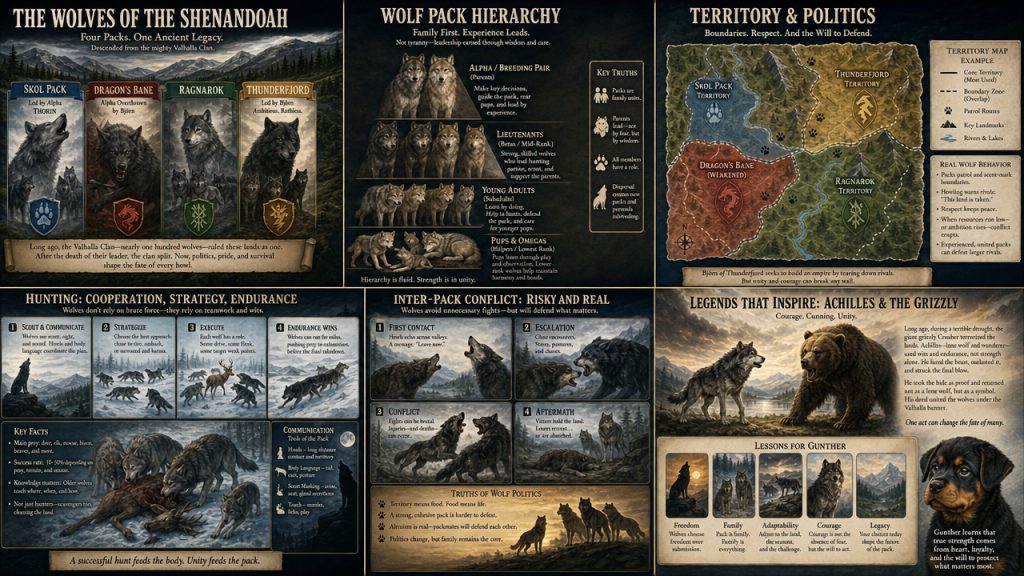
In The Smallest Rottweiler, Part 3, the wise wolf Magnus shares with the young Rottweiler pup Gunther the rich history, legends, and perilous politics of his world. The Skol Pack, led by the steadfast Alpha Thorin, stands as one of four packs—alongside Dragon’s Bane, Ragnarok, and Thunderfjord—descended from the ancient Valhalla Clan, a legendary super-pack of nearly one hundred wolves. This clan once unified the region before splitting after its leader’s death. Now, an ambitious wolf named Björn from Thunderfjord seeks to forge a new empire by conquering rivals, having already toppled Dragon’s Bane’s Alpha. To inspire resistance and shatter Björn’s “wall” of loyal lieutenants, Magnus undertakes a perilous trial: confronting the mighty grizzly Boris at Teal Lake, emulating the hero Achilles, who long ago slew the colossal grizzly Crusher through cunning and endurance during a devastating drought, earning a hide as proof and helping unite wolves under the Valhalla banner.
This fictional arc beautifully mirrors real gray wolf (Canis lupus) culture, offering readers a chance to learn authentic wolf behavior while immersing in the story. Below is a comprehensive narrative framework that weaves the book’s elements with science-based insights from wolf ecology (primarily gray wolves in North America, such as in Yellowstone National Park).
1. Pack Structure: Family First, Led by Experienced Parents (Not Tyrants)
In the story, Magnus describes packs of 15–20 wolves (sometimes more), mostly family-based but flexible, with hunting parties led by skilled Lieutenants under the wise Alpha’s guidance. This echoes reality closely.
Real wolf packs are typically family units: a breeding pair (often called the “alpha” male and female, though modern science emphasizes they are simply the parents) and their offspring from previous years. Packs average 5–12 members but can grow larger. The parents lead naturally through experience, not constant fights for dominance. Offspring follow their parents’ cues—leading travel, deciding rest spots, and prioritizing food access—because it ensures survival.
Key Roles (Simplified Hierarchy):
- Alpha/Breeding Pair (Thorin-like leaders): Primary decision-makers. They breed (usually only they do), guide hunts/moves, and maintain cohesion. The female often excels in pup-rearing and defense; the male in foraging/travel. They are not always the biggest or strongest, but the most experienced.
- Lieutenants/Betas or Mid-Rank Wolves: Strong hunters or helpers who lead subgroups, scout, or support. In the story’s hunting parties, this matches real “division of labor.”
- Younger Wolves/Pups: Learn by observing and participating. Dispersal (leaving to find mates/form new packs) prevents inbreeding and expands territory.
- Omegas or Lower Ranks: Often younger or less dominant; they help maintain social bonds through play and submission displays.
Chart of Typical Wolf Pack Hierarchy (Classic educational view; note that wild packs are fluid family groups rather than rigid military hierarchies):
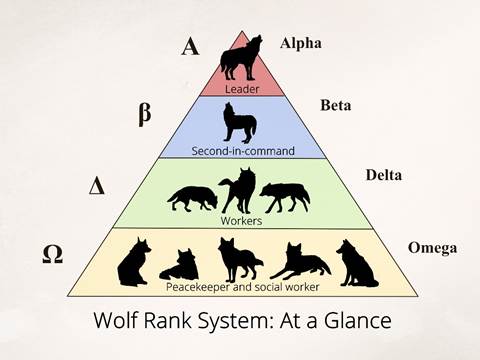
Wolf Pack Ranks: What Is an Alpha?
In the book, the Valhalla Clan’s split into four packs after its leader’s death reflects how real packs fission when they grow too large or resources dwindle—young wolves disperse to form new territories.
2. Hunting: Coordination, Strategy, and Endurance (Not Just Brute Force)
Magnus highlights hunting parties that are “fast enough to cover territory, disciplined enough to bring down prey.” Gunther participates in taking down a deer. This captures wolves’ legendary teamwork.
Real wolves are highly adaptable predators. They primarily hunt large ungulates (deer, elk, moose) but also smaller prey. Hunts involve:
- Scouting and Communication: Howls, body language (tail position, ear sets, postures), and scent mark territory and coordinate.
- Strategies: Cursorial (endurance chasing to exhaust prey), ambush (waiting at dens or trails), or surround-and-harass. Roles emerge naturally: some flank, some drive prey toward others, and experienced wolves target vulnerable areas (hamstrings, neck, flanks). No strict “general” issues orders—coordination emerges from shared knowledge and mutual benefit.
- Success Rate: Often low (10–50% depending on prey), emphasizing why pack unity and experience matter. Older wolves’ knowledge can tip the balance.
3. Territory, Politics, and Inter-Pack Conflict: The Struggle for Survival
The Shenandoah packs patrol ridges, valleys, and rivers, avoiding humans while facing threats like Björn’s expansionism. This parallels real territoriality.
Wolf packs defend exclusive territories (dozens to hundreds of square miles) marked by scent, howls, and patrols. Boundaries overlap slightly but are respected to minimize costly fights. Resources (prey, den sites) drive conflicts, especially in winter or when packs expand.
Real Inter-Pack “Warfare”:
- Encounters often start with howling standoffs or chases.
- Escalation can lead to fights, with serious injury or death (intraspecific strife is a leading cause of mortality in some populations, like Yellowstone).
- Experienced/older wolves and cohesive small packs can defeat larger ones through strategy and morale. Altruistic defense (packmates intervening) occurs.
Territory Map Example (from Yellowstone studies, showing overlapping or defended ranges):
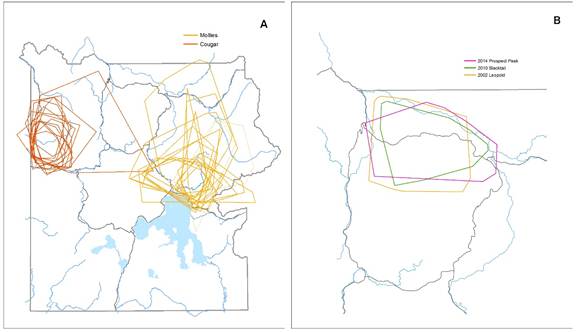
Wolf Turf: A Glimpse at 20 Years of Wolf Spatial Ecology in Yellowstone (U.S. National Park Service)
In the book, Björn’s conquest of Dragon’s Bane and “wall” of lieutenants mirrors how a dominant pack or ambitious breeders can absorb survivors or displace rivals, reshaping the regional “political” landscape. The four packs’ neighboring territories and shared Valhalla heritage reflect how real wolf populations maintain genetic and cultural connections across landscapes while competing.
Magnus’s howl to announce presence and the Feather Network (ravens as messengers) poetically extend real long-distance communication via howls that carry miles.
4. Legends and Cultural Resonance: Achilles and Valhalla in Wolf Lore
The Achilles legend—solo (or near-solo) victory over a grizzly through wits during hardship, leading to unity—draws from broader wolf symbolism. Wolves feature prominently in global myths as teachers, warriors, protectors, and creators (e.g., Romulus and Remus raised by a she-wolf; Native American stories of wolves as loyal hunters or culture heroes; Norse ties to Odin).
There is no single “Achilles wolf” in folklore, but the motif of a heroic individual whose deed inspires collective strength aligns with wolves’ real cooperative ethos. The Valhalla Clan evokes Norse-inspired grandeur, fitting wolves’ fierce yet familial nature. In the story, defeating Boris like Achilles breaks fear and shifts power—much like how a real pack’s successful defense or bold action can deter rivals and bolster alliances.
Why This Matters for The Smallest Rottweiler Readers
Gunther’s journey from domestic pup to understanding wild freedom parallels the contrast between human-managed dogs and independent wolves. Real wolves choose “freedom instead” of submission, thriving through family bonds, adaptability, and resilience—traits Magnus embodies. By facing Boris, Magnus isn’t seeking glory alone but preserving his pack’s way of life against conquest, echoing how real packs fight for territory to ensure future generations.
Wolves are not mindless killers but intelligent, social carnivores whose “politics” revolve around survival, kinship, and balance with their ecosystem. They help control prey populations, benefiting biodiversity. The story’s themes of courage, legacy (Thorin’s leadership), and one decisive act (the “tipping point”) teach empathy for these remarkable animals.
HOW A PACK OF WOLVES WORKS | Hierarchy of the wolf pack
This framework enriches the fictional arc: as Gunther learns from Magnus across the chapters, readers gain accurate insight into wolf culture—family-driven packs, strategic hunting, territorial defense, and the power of legends to inspire. The Smallest Rottweiler thus becomes not only an adventure but a bridge to appreciating real wolves in the wild. Magnus’s warning about humans seeking control versus wolves choosing freedom resonates with ongoing conservation efforts to protect their habitats and natural behaviors.