For decades, scientists believed meaningful communication between humans and animals would remain limited to trained responses, gestures, and emotional interpretation. While artificial intelligence could identify patterns in whale songs, primate calls, and canine vocalizations, true semantic translation eluded researchers. Animal vocal structures simply lacked the neurological consistency required for direct linguistic interpretation.
That changed in 2023 with the development of the Canine Vocal Translator (CVT), commonly known as the Harmonic Bridge — or, in technical circles, the Adaptive Resonance Vocal Interpreter (ARVI) unit. First certified in late 2023 and deployed in specialized research settings by 2024, the Harmonic Bridge represents one of the most significant breakthroughs in interspecies communication of the 21st century. Its success depends on an extraordinarily rare neurological condition found in fewer than 0.03% of canines.
Origins of the Invention
The breakthrough emerged from a joint international effort involving neuroacoustic engineers, veterinary neurologists, and cognitive linguists. While Dr. Elena Voss and her team at the Neurophonics Institute in Zurich were studying auditory processing in aging service dogs, another key discovery occurred during long-term behavioral evaluations at the North Carolina Comparative Cognition Institute under Dr. Elias Mercer.
What began as research into emotional interpretation systems for therapy and working dogs unexpectedly revealed something far more profound. Using advanced magnetoencephalography (MEG), real-time laryngeal ultrasound, and high-resolution functional MRI, researchers identified “anomalous harmonic clusters” in certain dogs. A small subset of subjects produced vocalizations with unusually stable, phase-locked neural oscillations. These created consistent harmonic overtones capable of carrying complex, layered information.
By mid-2022, the first functional prototype existed. Early 2023 brought reliable, context-aware translation. The delay was not due to hardware, but the extreme rarity of compatible subjects. After testing thousands of animals worldwide, researchers confirmed that only a tiny fraction possessed the precise cerebral architecture necessary for high-fidelity translation.
How the Device Works
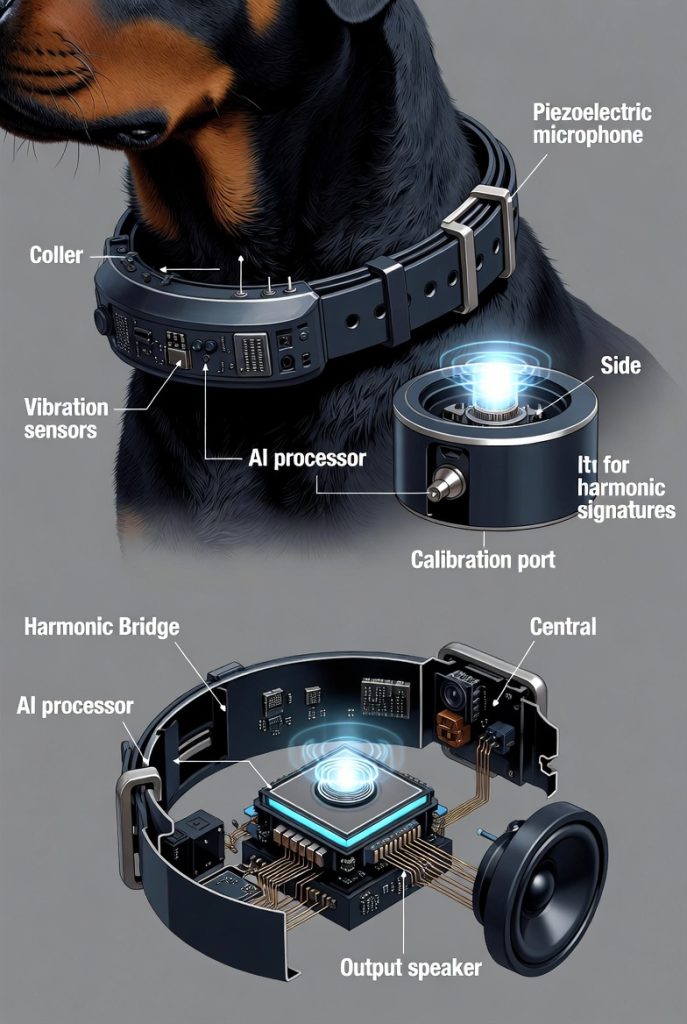
The Harmonic Bridge consists of three integrated components:
1. The Receiver Collar: A lightweight, durable black-and-silver band equipped with high-sensitivity piezoelectric microphones and vibration sensors. It captures both airborne sound and bone-conducted laryngeal resonance.
2. The Neural Mapping Processor: A compact AI-driven module that analyzes incoming vocalizations against the subject’s unique pre-calibrated harmonic signature. Using deep learning algorithms trained on massive cross-referenced datasets of vocalizations and brain imaging, it decodes meaning in real time.
3. The Semantic Output Interface: This reconstructs the processed signal into natural-sounding human speech, preserving the speaker’s emotional tone, cadence, and personality.
The system does not invent language. It decodes meaning already encoded in the complex harmonic structure of the animal’s vocalizations. For conversational fluency, the subject must produce exceptionally stable neural firing patterns.
The Harmonic Signature Effect
This rare neurological phenomenon is now formally known as the Harmonic Signature Effect.
In most dogs, neural firing in vocalization centers is chaotic and broadband, producing expressive but inconsistent harmonics. However, in a tiny number of individuals, clusters of neurons in the laryngeal motor cortex, temporal, and limbic regions achieve an unusually stable harmonic resonance. Their firing patterns lock into discrete frequency bands that remain phase-coherent across repeated vocalizations — creating a “neural symphony” where each sound carries multiple layers of encoded information.
The effect produces a distinctive “signature” waveform: a stable resonant fingerprint unique to each compatible individual, yet sharing common mathematical properties. Researchers trace it to a combination of genetic factors and early developmental neuroplasticity. To date, fewer than two dozen animals worldwide have demonstrated the capacity for full conversational fluency with the device. Among dogs, the number is even smaller — perhaps fewer than ten confirmed cases as of 2026.
The Case of Gunther
Gunther, the elderly Rottweiler, became the poster subject for the Harmonic Signature Effect after rigorous testing in 2024.
During a routine evaluation at the North Carolina Comparative Cognition Institute, Gunther’s scans revealed an extraordinary degree of neuronal synchronization. His neurons fired in tight harmonic resonance, particularly in the 180–450 Hz range matching his natural vocal timbre. This resonance proved remarkably stable, resistant to age and environmental stress.
Dr. Voss described Gunther’s brain as “a natural amplifier for semantic harmonics.” His patterns maintained coherence nearly forty times longer than any previously recorded canine subject. Most compatible dogs require weeks of training; Gunther achieved fluent translation within hours.
This exceptional compatibility has allowed him to share detailed autobiographical accounts, emotional reflections, and philosophical observations with human audiences. While most resonance-capable animals communicate in fragmented emotional impressions, Gunther demonstrates temporal continuity, introspection, and narrative structure approaching human storytelling.
Implications and Future Outlook
The extreme rarity of the Harmonic Signature Effect has sparked intense ethical debate. Some researchers advocate for targeted breeding programs, while others caution against unintended neurological trade-offs.
For now, the Harmonic Bridge remains a specialized tool available to only a handful of extraordinary animals. Its existence highlights both the wonder and the limitations of our efforts to understand other species.
Gunther himself often reflects on the bittersweet nature of the technology. “I can finally speak with you,” he has said, “but only because my brain sings in a way that very few others do. Most of my kind remain mysteries, even to those who love them.”
As machine learning advances, scientists hope to broaden compatibility. Until then, the Harmonic Signature Effect stands as both a rare gift and a humbling reminder of how much in the world around us still remains untranslated.
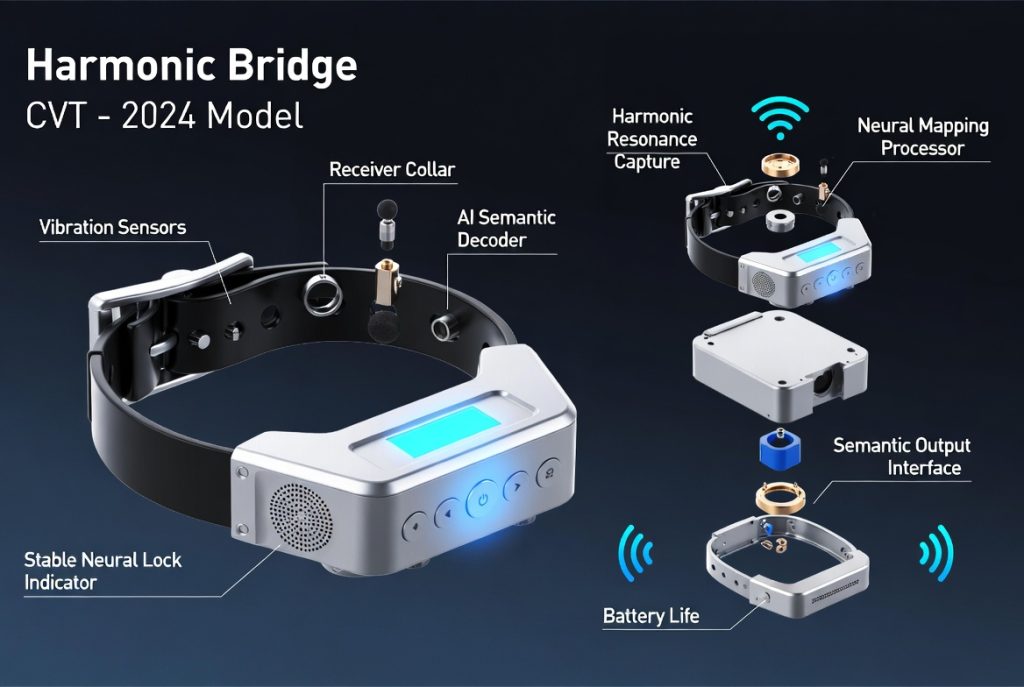
Adaptive Resonance Vocal Interpreter (ARVI) unit
Scientific Journal Research Article (Not Real, created for entertainment purposes only)