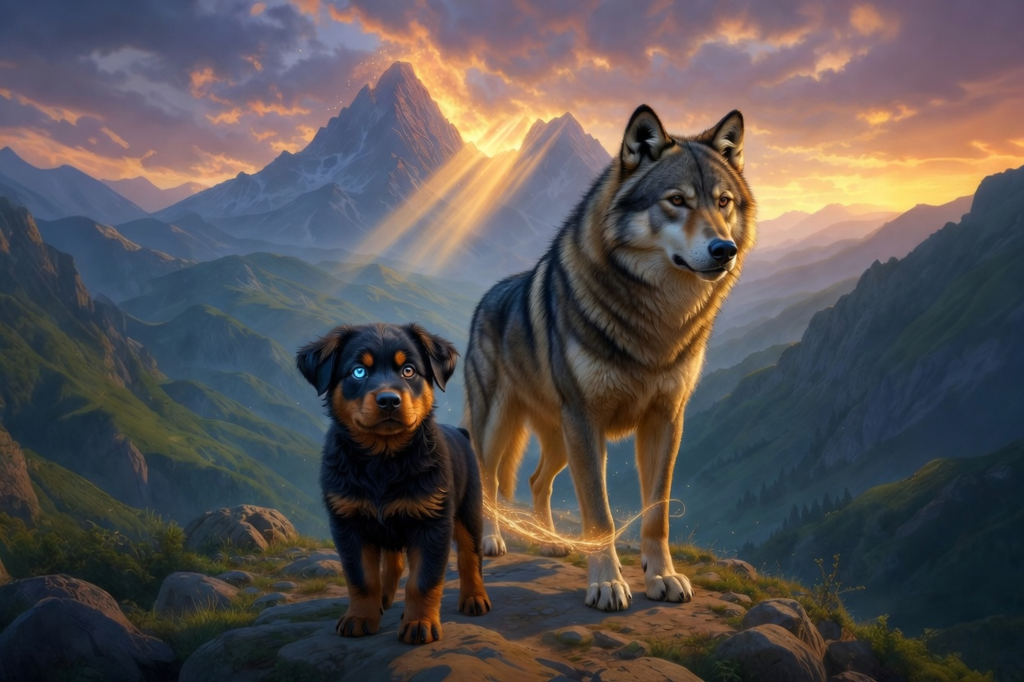
In the world of The Smallest Rottweiler, wolves refer to domestic dogs with a single word:
Ca’lu’ris.
The word is a shortened form of Canis lupus familiaris, stripped down to its barest bones: Ca from Canis, lu from lupus, and ris from the trailing sound of familiaris. What remains is a compact, sharp-edged word that rolls from a wolf’s tongue like a half-sneer. To a dog’s ears, it may sound simple, but among wolves, it carries centuries of meaning.
Loosely translated, Ca’lu’ris means the tamed wolf, the surrendered one, or the one who chose to be known. The exact meaning depends on the speaker and the moment, but every interpretation carries the same implication: a creature that traded freedom for comfort.
To wolves, names are never merely labels. Names are judgments. They tell the story of what a creature is and where it stands within the natural order. The word Ca’lu’ris, therefore, serves as both identification and accusation.
Among wolves, an ancient belief persists that long ago all canines shared the same path. They hunted beneath the same stars, followed the same migrations, and answered only to the pack, the wilderness, and the moon. Then, according to wolf tradition, some chose a different road. They approached the fires of humans. They accepted food they had not hunted. They slept behind walls they had not built. Over time, they surrendered pieces of themselves for safety.
Whether the story is entirely true no longer matters.
What matters is that wolves believe it.
Generation after generation, the tale became part of their collective memory. The first dogs became symbols of a choice wolves could never understand: choosing certainty over freedom, comfort over independence, and obedience over self-determination.
To a wolf, this was not evolution.
It was abandonment.
As centuries passed, the meaning of Ca’lu’ris hardened. It became a reminder of what wolves believed had been lost. Dogs grew smaller, more varied, and more dependent upon humans. Their lives became intertwined with masters, homes, fences, and commands. Wolves looked upon them and saw reflections of what they might have become had they abandoned the old ways.
That is why Ca’lu’ris is rarely spoken as a neutral term. Even when not intended as an outright insult, it carries an undercurrent of pity, disappointment, and suspicion. A wolf hearing the word imagines a creature that has forgotten its birthright.
Yet language, like loyalty, is not always fixed.
When Magnus first uses the word for Gunther, it is not spoken with simple contempt. It is spoken as a test.
Magnus sees before him a small runt with mismatched eyes—a creature born among the Ca’lu’ris and burdened by every expectation attached to that name. By all appearances, Gunther should embody everything wolves distrust: weakness, dependence, and submission.
Yet something about him does not fit the story.
Again and again, Gunther refuses to remain within the boundaries others place around him. He endures ridicule without surrendering his spirit. He faces dangers far beyond his size. He chooses courage when fear would be easier. Each trial forces Magnus to confront an uncomfortable possibility: perhaps the old judgments are incomplete.
Perhaps a dog can still carry the heart of the wild.
Throughout their journey through fire, water, shadow, and sacrifice, Gunther steadily challenges everything the wolves believe about the Ca’lu’ris. He does not earn respect through strength alone. He earns it through perseverance, loyalty, and an unbreakable will. Where many larger creatures would have turned away, Gunther continues forward.
By the end of their journey, the meaning of the word itself has begun to change.
Then Magnus does something unprecedented in wolf culture.
As the new leader of the Pack, he publicly grants Gunther an equal place among them.
For generations, wolves had measured dogs by what they lacked. They were Ca’lu’ris—the diminished descendants of those who had abandoned the old covenant. No dog had ever truly stood as an equal beneath the eyes of the Pack.
Until now.
Before wolves and companions alike, Magnus declares that Gunther is not a Ca’lu’ris.
He is a brother.
The moment carries far greater weight than a simple welcome. In wolf tradition, to name a creature is to define its place in the world. By refusing the old title, Magnus overturns centuries of prejudice. He strips away every assumption attached to Gunther’s birth and replaces judgment with recognition.
For the first time, a wolf leader acknowledges that ancestry alone does not determine worth.
Magnus no longer sees a dog trying to become a wolf.
He sees a soul who has already proven himself worthy of standing beside one.
In that moment, the word Ca’lu’ris loses its power over Gunther. The label that once defined him can no longer contain him. Magnus looks beyond the small body, beyond the mismatched eyes, and beyond the history that separates wolves and dogs. What he honors instead is the courage that refused to break, the loyalty that never wavered, and the spirit that ran toward danger when others turned away.
Gunther is no longer measured by what he was born.
He is measured by what he chose to become.
And in the eyes of the wolves who once saw only a dog, he now stands as one of their own.