THE MORNING REVIEW
Books & Culture · Weekend Edition · Summer 2026
────────────────────────────────────────────────────────────────────────────────
The Runt Who Refused to Disappear
Patrick Gallagher’s The Smallest Rottweiler is the animal novel readers of Charlotte’s Web and Watership Down have been waiting decades to find again
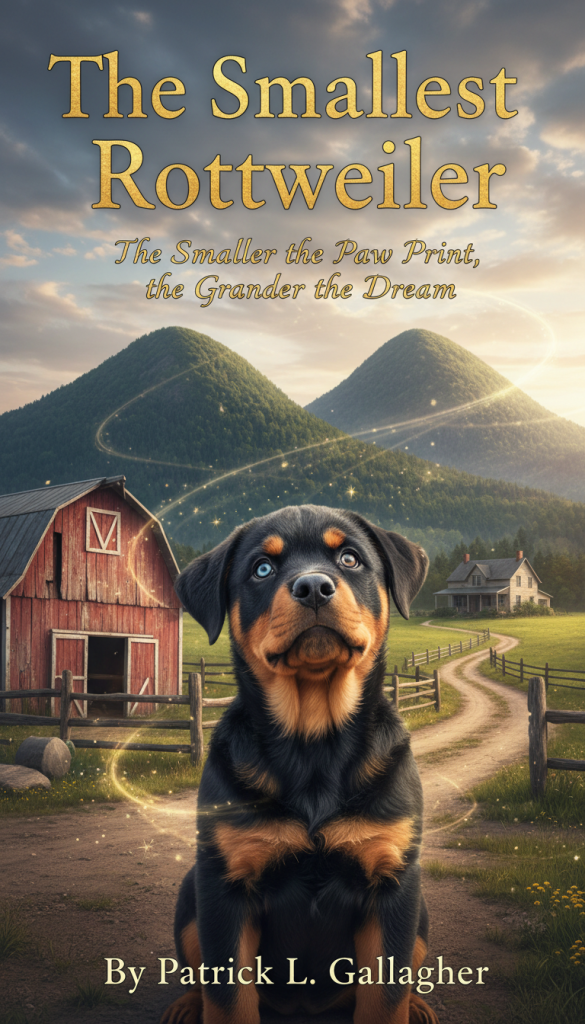
The Smallest Rottweiler · Patrick L. Gallagher · 293 pages · Reviewed by the Books Desk
────────────────────────────────────────────────────────────────────────────────
The scene arrives in the second chapter and it is over in a single sentence. A Rottweiler father looks down at the seventh and smallest puppy in the litter — barely filling the space between his forepaws, one eye warm brown, the other ice blue — and says one word: “Mongrel.” Then he walks away.
His wife watches him go. She bends close to the tiny creature’s ear. She names him after her father. Then she begins to sing.
In that exchange — rejection and love occupying the same breath — Patrick Gallagher establishes everything his novel will be about. Worth that is unseen. Tenderness that does not require permission. The long, often painful distance between the two. Everything that follows is the story of one small dog and one improbably large heart finding their way toward each other across the space that distance created.
“The thirty years show on every page in the best possible way. This is not a writer manufacturing emotion. This is a writer delivering on a promise made to himself across decades.”
Gallagher has been working on this story, in one form or another, for over thirty years. He wrote an early version as a Christmas gift for his mother in 1992 — a hand-bound copy typed out by a young police officer who had never owned a Rottweiler and couldn’t fully explain why the breed had chosen him for this story. That original copy still exists, owned now by his sister — named, with a novelist’s instinct for resonance, Lynda. The book you hold is the result of revisiting that story in his sixties, after real Rottweilers, a real son named Gunther, and a lifetime of experience had given him considerably more to say.
The novel follows Gunther — the smallest pup, the mismatched-eyed runt his father cannot quite bring himself to look at — from birth through his early adventures at Pantak’s Kennel, his accidental escape into the wider world, and his improbable journey toward becoming the first Rottweiler to serve as a police K-9. The story is told at fourteen years’ remove, an aged and decorated Gunther narrating through a miraculous translation device, his voice reaching both a human studio audience and a room full of young K-9 recruits who see in him the living proof that origin does not determine destination.
The book is considerably more ambitious than its premise suggests, and considerably more successful than its modest origins might predict. It is, at its best, the real thing: a novel with genuine literary heft, a moral intelligence that never lectures, and a prose style that earns its comparisons to Charlotte’s Web rather than simply claiming them.
“The middle section — in which Gunther befriends a wolf named Magnus and becomes entangled in a contest for wolf-pack dominance that echoes classical Norse mythology — is the book’s most surprising and inventive passage.”
Magnus is one of the more memorable animal characters in recent fiction. Fierce and funny and ultimately noble, he carries the book’s central tension between belonging and freedom, between the world that shapes you and the world you choose. His friendship with the small Rottweiler puppy has the genuine quality of the best literary friendships: each character changes the other, and the reader changes too in the watching.
The climax, in which a bank robbery and a hostage situation converge at the kennel where Gunther was born, is handled with considerable thriller skill. Gallagher manages action mechanics — the bullet hole that identifies a getaway car, the copper-wire improvised radio antenna, a dog bursting through a car window under fire — with the same confidence he brings to the quietest emotional scenes. The forgiveness scene between the lying brothers and their grieving parents arrives a touch quickly, and one key reunion happens off the page rather than on it. These are notes toward excellence, not indictments.
“What Gallagher has accomplished here is something genuinely difficult: he has written an animal story that does not condescend to its animal characters. They live according to their own logic, their own grief and pride.”
The book’s best argument is the one Gunther makes in the final chapter, to the recruits gathered around him: that dogs and humans are not two kinds of creatures living side by side, but one ancient story — of beings who chose each other long before either knew what the choice would mean. That argument is not a sentiment. It is a thesis. And Gallagher earns it on every page.
| THE VERDICT ★ ★ ★ ★ ½ out of five stars Emphatically recommended. A novel of genuine emotional intelligence, a confident prose style, and the rare courage to believe that a small dog’s story can carry the weight of everything that matters. Buy it. Give it away. Read it twice. |