Theme 1: Identity & Belonging
“The Lord does not look at the things people look at. People look at the outward appearance, but the Lord looks at the heart.” — 1 Samuel 16:7 (NIV)
Gunther is born the smallest in the litter, immediately set apart by his mismatched eyes and tiny size. From the first chapter, he must decide who he is in a world that seems to have already decided for him.
Discussion Questions
- When Alexander turns away from Gunther at birth, how does Millicent respond? What does her choice say about how she defines worth?
- Gunther’s mismatched eyes — one brown, one blue — make him different from everyone else. Have you ever felt different in a way that others noticed but you couldn’t change? How did you handle it?
- MJ tells Gunther, “You’ve got the sky in one eye and the earth in the other.” What do you think he means by that? How can something that makes us different also be a gift?
- By the end of the book, Gunther has become the first Rottweiler K-9 officer. How did he prove that identity is built through choices, not just birth?

Theme 2: Courage & Perseverance
“Courage is not the absence of fear, but the triumph over it.” — Nelson Mandela
Gunther faces the river, the wilderness, a bear, and an armed criminal — not because he isn’t afraid, but because he chooses to act anyway. True courage, the book argues, is never the absence of fear.
Discussion Questions
- When Gunther descends the waterfall to reach Magnus in time, he is terrified but does it anyway. Can you think of a time when you did something brave even though you were scared?
- The old Rottweiler in Gunther’s dream says: “A wish is not a plan. Luck fades quickly.” What is the difference between wishing for something and working toward it?
- Gunther plants himself in the clearing and refuses to run when Willie aims at him. What do you think gave him the strength to stand still in that moment?
- Magnus tells Gunther he must face the grizzly bear alone to prove his worth. Do you think there are times when we have to face something difficult alone? When is it okay to ask for help?

Theme 3: Prejudice, Fairness & Second Chances
“Heart matters more than bloodlines. We need more dogs like Mitchell — ones who judge character before pedigree.” — Marlene, The Smallest Rottweiler
The book uses “breed prejudice” — the assumption that German Shepherds make K-9 officers and Rottweilers don’t — as a mirror for the way humans sometimes judge others by category rather than character. Marlene, MJ, and Mitchell each represent a different response to that bias.
Discussion Questions
- Chloe tells Gunther, “Only German Shepherds become police K-9s. Everybody knows that.” Where do you think that belief came from? Is “everybody knows” ever a good reason to accept something as true?
- MJ admits he never questioned the rule that Rottweilers didn’t become K-9 officers: “It’s simply how I was taught.” Why is it sometimes hard to question the rules we grew up with?
- Marlene challenges MJ’s thinking with quiet but firm words. What is the difference between arguing and persuading? Why does Marlene’s approach work when anger might not?
- Willie receives extra prison time for assaulting a police dog and carries resentment for years. Does a fair punishment always feel fair to the person being punished? What does the story suggest about justice versus revenge?
- Mitchell gives everyone at his kennel — purebreds and mixed breeds alike — the same care and respect. How does his example change the world around him?

Theme 4: Family, Forgiveness & Redemption
“He was lost, and is found.” — Luke 15:24 (NIV)
The relationships between Gunther and Alexander, and between Max, Smalls, and their parents, carry the book’s deepest emotional weight. Forgiveness here is not forgetting — it is choosing love over resentment, and growth over pride.
Discussion Questions
- Alexander rejects Gunther at birth because of old pain — the death of his own mother during whelping. Can you understand why pain from the past sometimes makes people act in hurtful ways in the present? Does understanding why someone hurts you make it easier to forgive them?
- Max and Smalls lie about what happened to Gunther, then leave on a dangerous journey to make it right. What motivated them to try to fix what they had done? Is that enough to earn forgiveness?
- Alexander tells his sons: “I will not judge you by your failures. I will judge you by the courage you showed when you rose to make amends.” Do you agree with this standard? What does it require of the person being forgiven — and the person doing the forgiving?
- When Millicent runs to Gunther and shouts his name, the scene is one of pure reunion. What does that moment say about a mother’s love? Why does the author choose not to use long words or explanations for that scene?
- MJ confesses that he sealed the tunnel — and that his effort to protect the pups unintentionally made things worse. How does the book treat well-meaning mistakes differently from selfish ones?

Theme 5: Loyalty & True Friendship
“What is a real friend?” — The old Rottweiler, from Gunther’s dream
The book asks this question explicitly — and then answers it through action rather than words. Magnus saves Gunther’s life without being asked. Gunther turns back from the highway to try to save Magnus. Caitlynn hears Gunther’s name before any technology could translate it. Loyalty, the book argues, is not spoken. It is proven.
Discussion Questions
- Magnus saves Gunther from the river without knowing him at all. What do you think motivates someone to help a stranger at great personal cost?
- Gunther turns back from the highway — giving up his dream of reaching the K-9 range — to try to help Magnus face the bear. What does that choice reveal about his character? What would you have done?
- Caitlynn feels Gunther’s name before she knows it. The book calls this “resonance” — a connection beyond words. Have you ever felt a bond with someone (or an animal) that was hard to explain?
- MJ has been loyal to Mitchell and to the kennel for years, quietly protecting everyone without asking for recognition. Is quiet loyalty more valuable than loyalty that announces itself? Why or why not?

Bringing It All Together
Whole-Book Discussion Questions
- The book is titled The Smallest Rottweiler, but by the end Gunther is not small in any way that matters. What does “smallest” mean by the final chapter?
- The author uses dogs and wolves to explore human experiences — prejudice, trauma, pride, forgiveness. Why might it sometimes be easier to explore difficult human themes through animal characters?
- Each Part of the book opens with a scripture passage and a literary or historical quote. Choose one that resonated with you and explain how it connects to the events of that section.
- The Harmonic Bridge — the device that lets Gunther’s voice be translated — is a metaphor as much as a technology. What does it represent about the relationship between humans and animals, or between people who cannot easily communicate?
- If you could add one chapter to the book, what would happen in it? Who would it focus on, and what question would it answer?
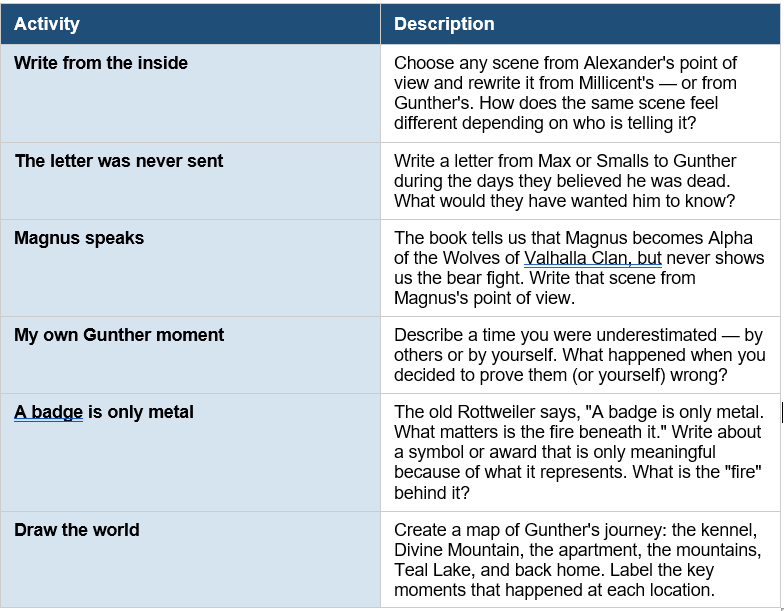
Creative & Writing Activities
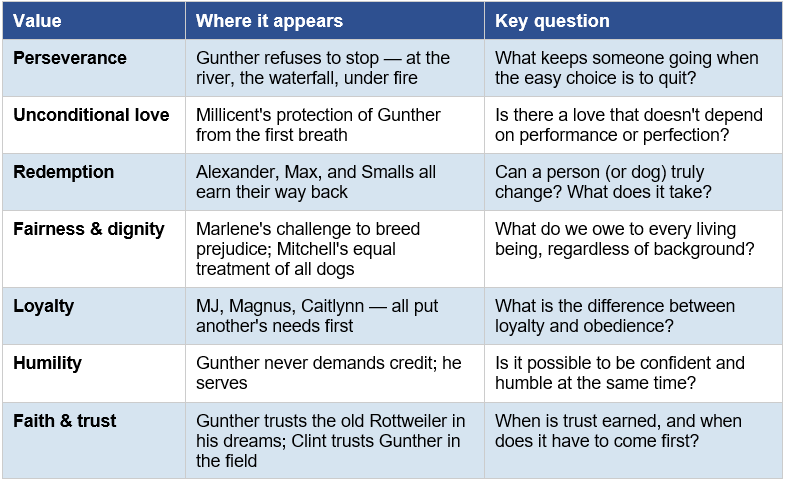
Core Values in The Smallest Rottweiler
Use this reference for classroom character education, home-school value discussions, or book club reflection.
Scripture & Literary Connections
The epigraphs opening each Part of the novel pair biblical scripture with literary and historical voices. Below are the connections with brief notes for discussion.
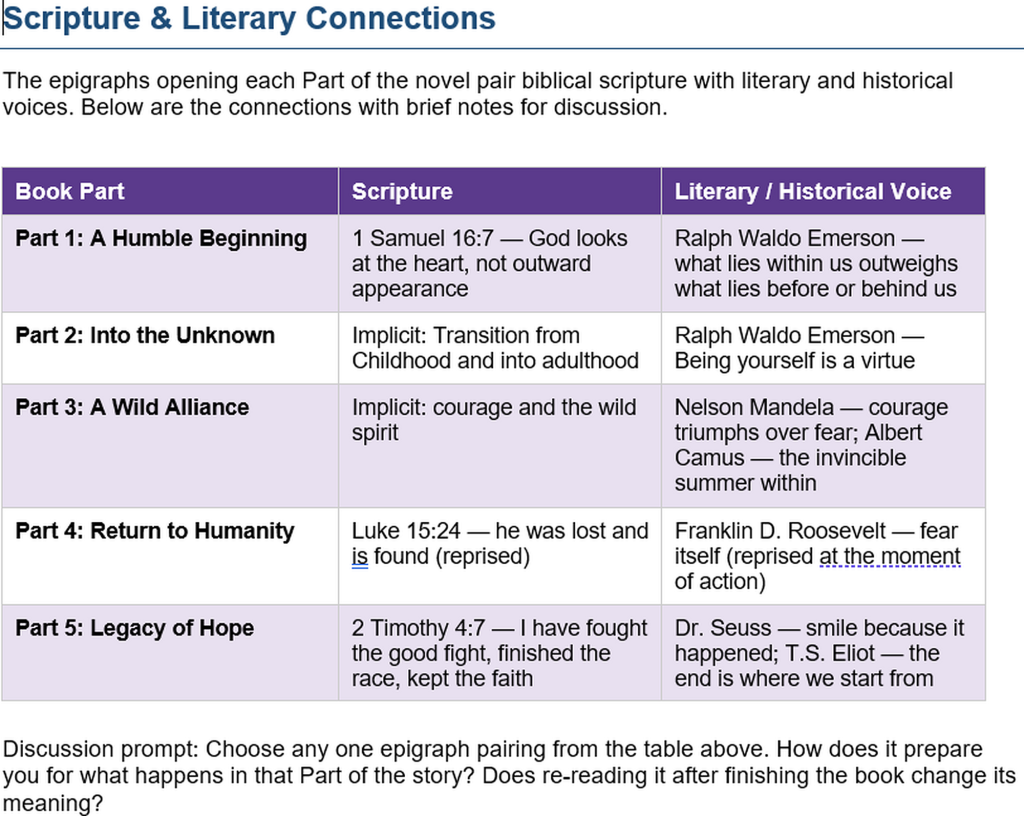
Discussion prompt: Choose any one epigraph pairing from the table above. How does it prepare you for what happens in that Part of the story? Does re-reading it after finishing the book change its meaning?
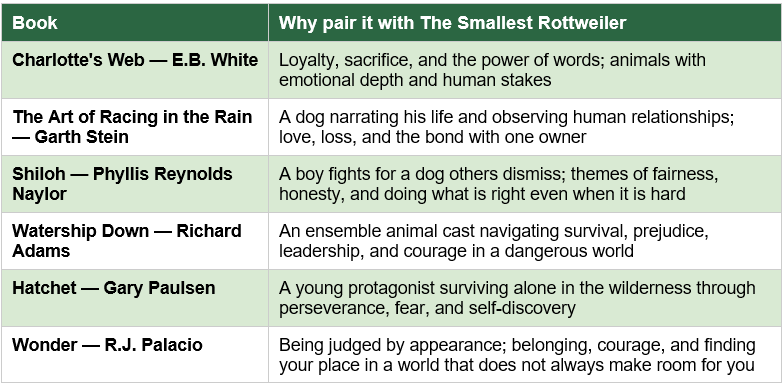
Companion Reading & Similar Books