William Calhoun was born into a world that seemed not to care whether he existed at all. His father could have been any number of men his mother drifted through life with, hoping one might help her build something stable. Sadly, the absence of a father was matched by the absence of a true mother. Though she stayed around long enough to make sure little Willy had food and clothes, she was never a meaningful presence when he needed guidance most.
When he was twelve years old, he earned the nickname “Crazy Willie” from the other street kids. He spent his first night in juvenile lockup just before turning thirteen—not because he truly belonged there, but because his mother refused to pick him up after he ran away and was caught shoplifting cigarettes from a convenience store.
There was a time when his path toward a life of crime might have been diverted. There was no shortage of well-intentioned social workers and juvenile intake officers who tried to help him, but there is no such thing as a truly impactful part-time mentor.
By the time he turned eighteen, he was already incarcerated for grand theft-auto and sentenced to the same juvenile facility where he had spent two earlier birthdays serving time for prior convictions.
Trouble clung to Crazy Willie like a shadow. Over the next several years, he drifted in and out of prison for a wide range of crimes. He was now forty-five years old with nothing to show for himself but a rap sheet as tall as he was.
After serving his last “deuce”—inmate slang for a two-year sentence—Willie began strategizing how to score big on his next job. He had learned that burglary carried less risk and often lighter sentences than violent crimes. Watch a house for a few days, learn the residents’ routines, slip inside, and disappear before anyone noticed.
He also learned that wealthy neighborhoods offered the best opportunities. Expensive cars. Landscaped lawns. Massive homes that people insisted on calling “estates.” Willie laughed at the word. Rich people always seemed to invent fancy names for their stuff.
Though he had no interest in cutting grass for a living, he spent time around landscaping crews and picked up useful information from workers who serviced affluent neighborhoods.
One particular house caught his attention. According to what he had heard, the owners kept valuable items in plain sight and possibly expensive jewelry, firearms, and collectibles inside. Willie spent several days watching the place.
What excited him most was the timing. Christmas was approaching, and through the front window he could clearly see wrapped presents stacked beneath a brightly lit tree.
He noticed the owners routinely left shortly after sunset and stayed gone for several hours. More importantly, there were no visible alarm signs or exterior security lighting. During one of his prison stays, Willie had learned how many alarm systems relied on visible contact sensors along doors and windows.
This house had none.
When the time finally came, Willie dressed in dark clothing, climbed the back fence, and crept toward the rear entrance. To his surprise, the back door was slightly open.
He hesitated only briefly before slipping inside.
What Willie failed to notice was an elderly neighbor watching from across the street. Suspicious of the stranger, she quietly called 911.
Inside, Willie found exactly what he had hoped for—a treasure trove of expensive electronics, collectibles, and valuables. Knowing he could carry only so much, he began piling potential items together while deciding what would bring the best return.
Ten minutes later, he spotted patrol lights outside.
Panic tightened in his chest.
Realizing the open back door would immediately draw police attention, he rushed over and locked it moments before an officer tested the handle.
“The house is secure,” one officer muttered outside. “Looks like the caller got spooked.”
Relieved for the moment, Willie crept toward the kitchen window and carefully parted the curtains.
Then he saw the K-9 unit arrive.
A German Shepherd stepped from the patrol car.
Willie cursed under his breath. He swore to himself he would never go back to prison.
Moments later, he heard the front door open.
“Police K-9!” an officer shouted. “Come out now or we’re sending in the dog!”
Full panic took over.
Willie grabbed a heavy coffee pot from the kitchen counter. He knew he could never outrun a police dog. If he had any chance to escape, he would have to disable the animal immediately.
The German Shepherd entered the dark kitchen low and alert.
Willie swung the coffee pot with every ounce of strength he had.
The impact cracked loudly through the room.
For one horrifying second, Willie thought he had killed the dog.
He bolted toward the back door, only to find two officers already waiting outside.
Their hands moved instantly to their weapons.
Willie froze.
Not because he thought they were fearless cops, but because he feared the opposite—that one nervous officer might accidentally shoot him.
At trial, Willie hoped for a plea agreement. Maybe a year. Another deuce at worst.
He was wrong.
He received two years for burglary and ten additional years for the malicious assault of a police K-9 officer.
His attorney later explained that the district attorney wanted to make an example of him. The sheer force Willie used against the dog had outraged both law enforcement and the court. The sentence became one of the harshest handed down in the state for that type of offense.
Willie would be fifty-seven by the time he walked out of prison.
Twelve Years Later
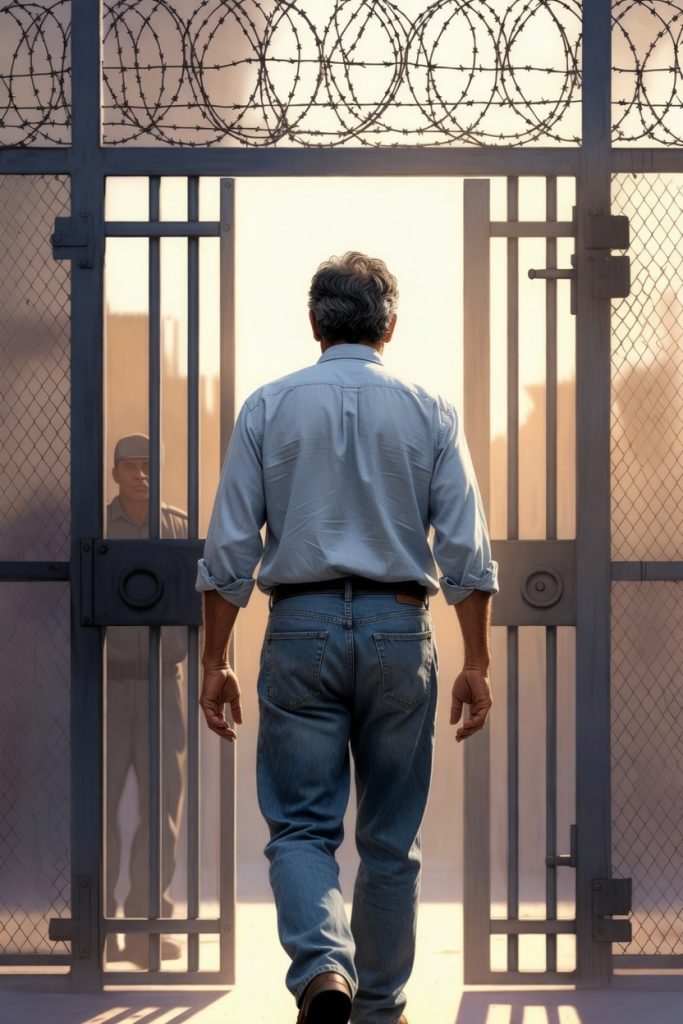
The first of three heavy, steel-barred doors buzzed open with a sharp electronic clang.
Standing just inside the threshold was a soon-to-be-freed inmate. Ill-fitting blue jeans hung loose on his lean frame, and his wrinkled button-up shirt—issued that morning from the prison’s release closet—clung uncomfortably to his shoulders. A fresh prison tattoo, still slightly raised and shiny, snaked down his right forearm, clearly visible beneath his rolled-up sleeves.
He moved through the release process in silence. Little was said between him and the guards. No well-wishes. No parting advice. Just the mechanical sounds of gates unlocking and boots echoing down the sterile hallway.
As he passed through the final door and stepped into the bright morning light, one guard called out behind him, his voice thick with contempt:
“I don’t care what that tattoo says. You’ll be back.”
The convict didn’t break stride. Without turning around, he raised his right hand and extended a single middle finger over his shoulder.
Only when the last gate slammed shut behind him did he allow himself a low mutter, barely audible even to his own ears:
“I’ve got plans.”
[Chapter 56 of The Smallest Rottweiler]
[Chapter 64 of The Smallest Rottweiler]
Sixteen years later.
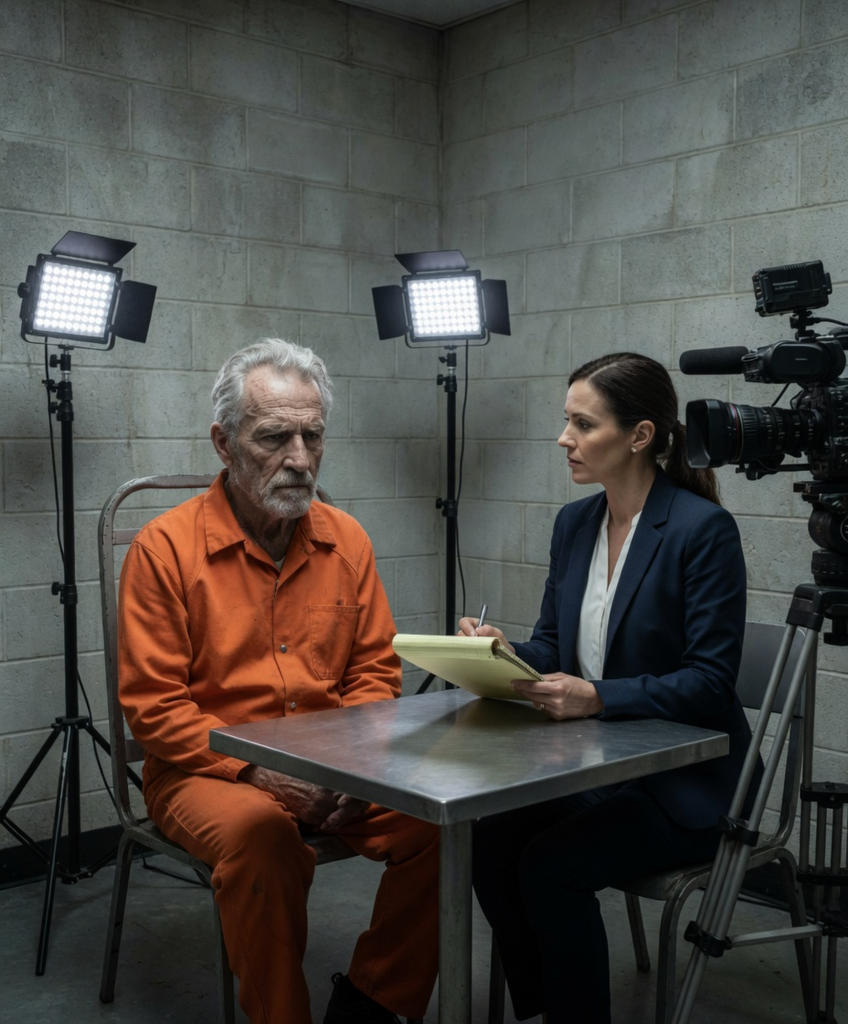
Now 71 years old, Crazy Willie has been counting his days. Not toward an eventual release, another “big score,” or proving he was the smartest man in the room. No, William Calhoun—who insists he no longer wishes to be called “Crazy Willie”—is counting down the days until he leaves this world and, in his words, “seeks peace in the blessing of the Lord.”
William spent several years in deep depression following his sentence to 122 years in prison for bank robbery, the shootings of two police officers, and numerous other crimes. It wasn’t until later that he said he found peace in the Lord and changed what remained of his life.
“I was a wicked man,” Calhoun told the reporter.
“My entire life was filled with darkness in my soul and emptiness in my heart.”
Since converting to Christianity, he has become a model inmate and mentors younger prisoners, using his own mistakes as an example of the regret that often follows a life of crime.
Four years earlier, his accomplice in the crime spree, Joseph “Joey” Watson, was released on parole, and Calhoun credits Watson’s remarkable transformation as an inspiration in turning his own life around.
“Joey has a good job, and he is a productive member of society,” Calhoun told the reporter.
“I want to make this clear. I convinced Joey to join me on that crazy day. Joey didn’t shoot anyone.”
The reporter informed Calhoun that, since he had been incarcerated, science had advanced considerably. She explained that one new invention allowed a small number of dogs to translate their language into human English.
Calhoun did not seem interested until the reporter pulled out an iPad and indicated that one such dog was the Rottweiler puppy he had fired at behind Pantak’s Kennel.
Calhoun turned sharply toward the reporter and fixed his attention on the iPad.
The reporter activated an icon on the screen. A video appeared showing Gunther seated in a studio chair with headphones over his ears and a microphone in front of him.
“Mr. Calhoun, I am Gunther. We were together for only a very short time, and I was very young then. As you can see, I am very old today.
“I have followed your life since your incarceration, and I want you to know that I am pleased you have found peace. My friend and mentor, MJ, the K-9 dog you injured many years ago, used to tell me, ‘Carrying a grudge is like closing an eye. Too many grudges will blind a person—or a dog.’
“MJ would never have held a grudge, and he would be equally pleased to know that when your time comes, the Enchantment will open its doors to you.”
Off to the side, someone cleared her throat.
“Oh, sorry. I think you call it Heaven.”
Gunther tilted his head slightly.
“Mother Nature—or God, as you may call It—wants all living things to exist in peace. Atonement and redemption are possible when peace is restored.
“Best of luck, Mr. Calhoun. I wish you the very best.”
The screen went blank.
William Calhoun placed his hands over his face and wept quietly. When he lowered them, he smiled warmly.
“That dog gave me a gift I did not imagine was possible. His forgiveness means more to me than anyone can ever know. I hurt a lot of people, and that includes some animals. Those K-9 dogs didn’t deserve the treatment I gave them, and the love and compassion shown by Gunther is something very special. Thank you for sharing it.
“By the way, if you get a chance to speak to Gunther, please tell him how wonderful his gift was to me and that I am grateful he is well. I followed his career too. I have read many news articles about the daring cases he worked throughout his career.”
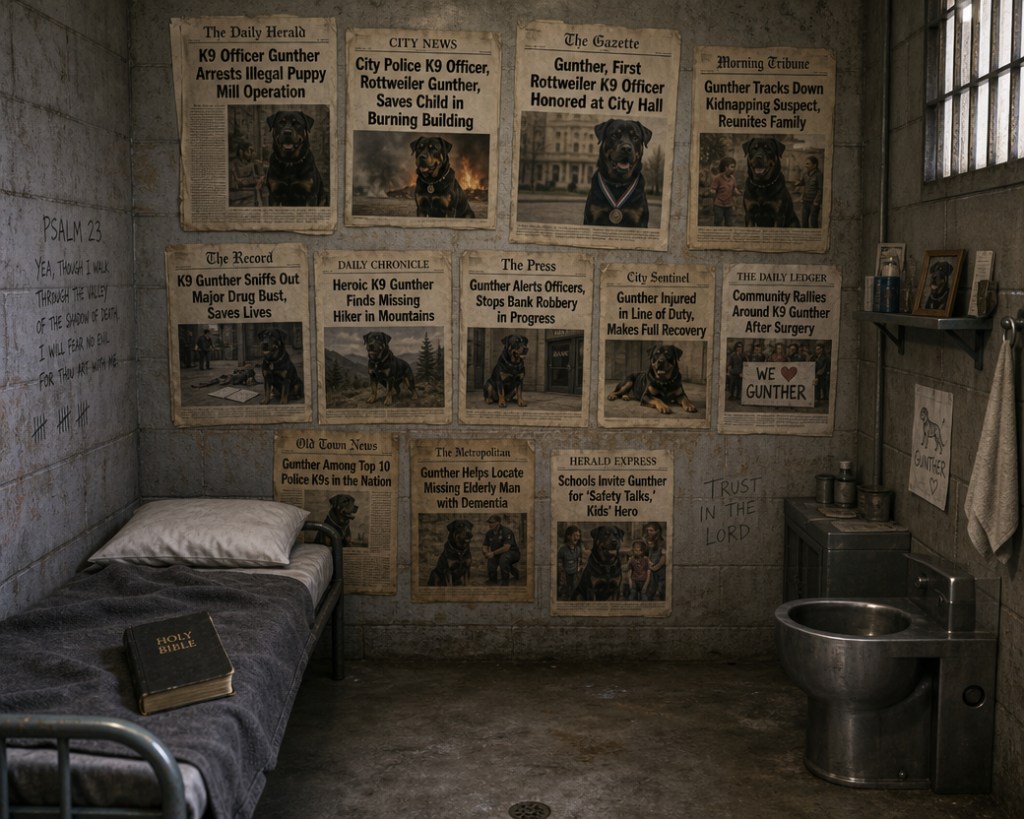
A month later, William Calhoun died peacefully in his sleep. What the reporter did not know when she interviewed him was that he had been diagnosed with a rare form of cancer and was not expected to live much longer. Covering the walls of his prison cell were news clippings detailing the many adventures of Gunther, the K-9 dog.
[Lyrics “Gunther’s Grace“]
[Verse]
Seventy-one years in a cage made of stone,
William Calhoun counts the days left alone.
Not for release, not another big score,
Just the peace of the Lord when he opens that door.
They used to call him Crazy Willie with pride,
Now he won’t answer to that name if he tries.
Bank jobs and bullets, two cops on the ground,
And a Rottweiler pup he tried to shoot down.
[Chorus]
But the Lord reached in where the darkness had won,
Turned a wicked old heart toward the light of the Son.
I was a wicked man, soul black as the night,
Emptiness heart and no end in sight.”
[Gunther – spoken/sung low]
“Mr. Calhoun, I am Gunther, grown old.
We were together one minute, I was barely grown.
I’ve followed your life since the day that you fell,
And I’m glad you found peace where the darkness once dwelled.
MJ told me grudges will close off one eye,
Too many and blindness will swallow you whole.
He’d never hold hate, and neither will I —
The Enchantment is open when it’s your time to fly…
Or Heaven, as you call it. Same door, different name.”
[Chorus]
Willie covered his face as the tears finally came,
A gift from the dog he had tried to erase.
“Your forgiveness means more than these walls ever could,
More than sermons or prayers or the ‘greater good.’
I hurt people and beasts, left a trail of regret,
But your voice broke the chains I could never forget.”
[Verse]
A month later the cancer took what was left,
Willie died peaceful, no fight, no regret.
But the walls of his cell told the story out loud —
News clippings of Gunther, every case, every crowd.
The K-9 who worked, who lived bold and true,
Whose last act of grace was to set Willie loose.Now Crazy Willie is gone with the wind,
William found rest where the long roads end.
Gunther’s gift was the key in the lock,
A dog’s simple mercy that shattered the rock.
In the blessing of Heaven, where grudges don’t stay,
Even convicts and Rottweilers find their way…
Yeah, even convicts and Rottweilers find their way.